The Penal Laws
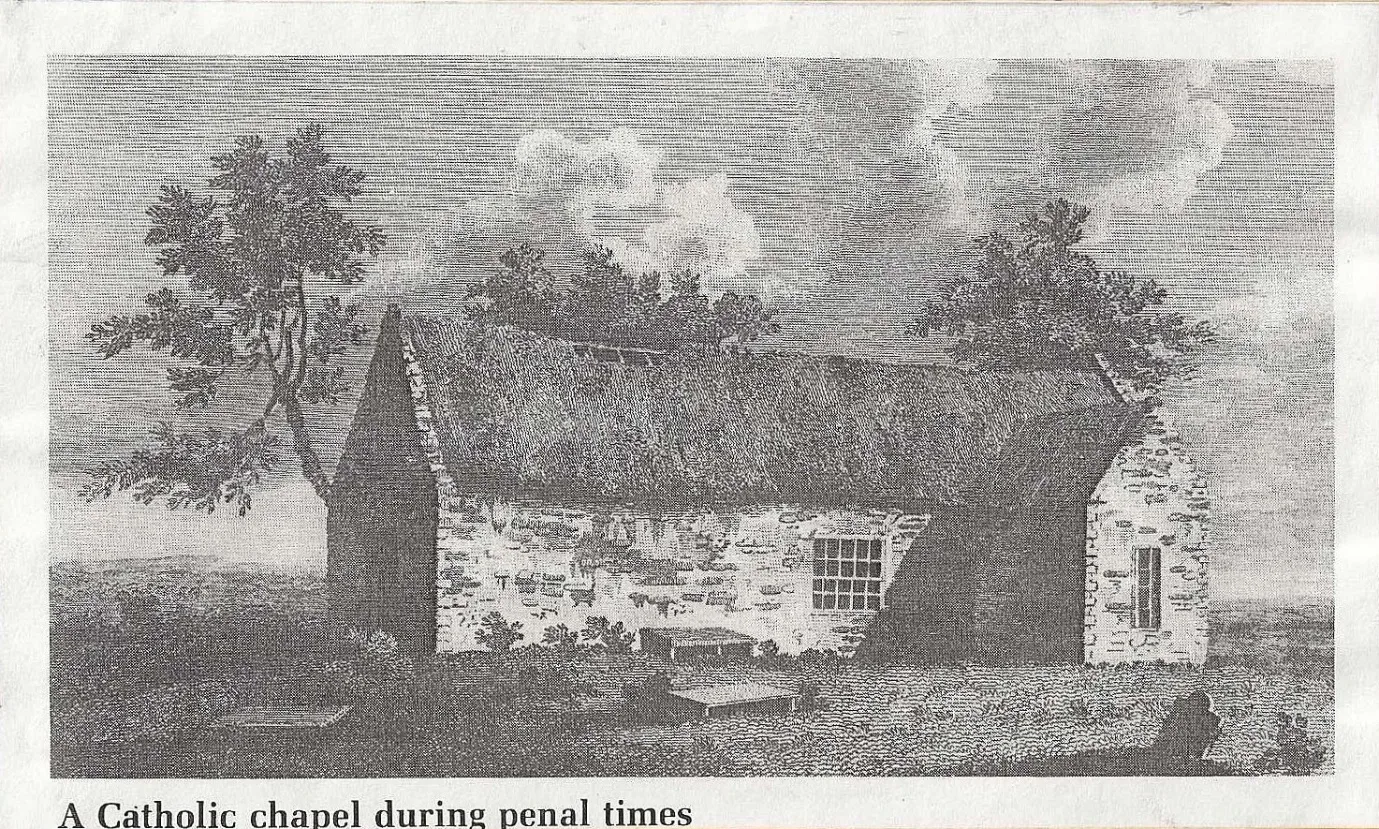
One can truly say that the faith was well established in our parish by the time of the Penal Laws. Despite persecution the people’s faith survived. We do indeed owe a debt of gratitude to our ancestors who, in the face of adversity, remained faithful to their beliefs. Between 1536 and 1790 the Penal Laws were enacted against Catholics penalising them for refusing to recognize the King/Queen a s Supreme Head of the Church. Fear, hunger and hopelessness stalked a people with no rights for the present or hope for the future, no schools, no property, no priests, no churches. They were denied the right to practise their religion-simply because their religion was not that of the ruling class.
Breaking these laws meant death or transportation. Only registered priests were allowed to remain in their parishes and they had to surrender their churches.
In Dean Cogan’s History of the Diocese of Meath we see that in 1704 the Rev. Thomas Fleming was registered in Trim, in accordance with the Penal Statute as ‘Popish Priest of Drumconragh, Ardagh, Loughbrackan and Inismot’. It is almost certain that the then ‘mud-wall, thatched Catholic Church’ (built in 1389-Graham 1974) was on the site now occupied by the Protestant Church (built 1775) having been surrendered under Penal Laws.
Researched and Compiled by Kathleen McArdle, “Brookville”, Drumconrath. Source: Faith History of Drumconrath – Meath Hill.